 What is Gibbs Reflective Cycle?
Have you ever wondered how reflecting on an experience could improve your personal growth and decision-making skills? Gibbs Reflective Cycle is a powerful model that helps you do just that. Created by Graham Gibbs in 1988, this model provides a structured approach to reflection that has become essential in various academic and professional fields. Whether you’re a student working on a project or a healthcare worker reflecting on patient care, the Gibbs Reflective Cycle can help you gain valuable insights and improve your practice.
By breaking down experiences into six stages, this model makes it easier to analyze what happened, how you felt, what went well, and what could have been done differently. It’s more than just looking back; it’s about growing and improving for the future.
Why Reflection Matters
Reflection isn’t just a buzzword—it’s a key tool for personal and professional growth. When you reflect on experiences, you gain deeper insights into your actions, reactions, and decision-making. This helps you understand what went well and what didn’t, allowing you to make better choices in the future.
For students, reflection can significantly improve your academic performance. It boosts your problem-solving skills, encourages critical thinking, and enhances your ability to learn from mistakes. Similarly, for educators and professionals, reflecting on experiences helps refine strategies and improve methods, leading to better outcomes for everyone involved.
Detailed Overview of Gibbs Reflective Cycle
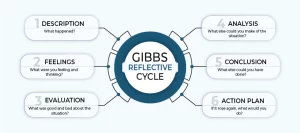 The Six Stages of Gibbs Reflective Cycle
The Gibbs Reflective Cycle is structured into six stages, each designed to help you think deeply about an experience, uncover meaningful insights, and improve future performance. Let’s break down each stage with richer detail and real-life examples that will guide you through the reflective process.
1. Description: What Happened?
The first stage is all about laying the groundwork for reflection. Here, you simply describe the event or experience in detail. The goal is to capture the key facts without jumping to conclusions or interpretations.
- What happened? What were the main events?
- Who was involved? Were you working alone, or was it a group effort?
- Where and when did this take place? Was there a specific setting or time that influenced the outcome?
Example: Let’s say you were part of a group project for a class presentation. You describe the project’s goal, the roles of each team member, and the final result. Perhaps, you found that the project had many moving parts—each team member had a specific section to present, and you were responsible for compiling the final report. However, the presentation was chaotic, with some members missing their cues, and it didn’t go as planned.
This stage is essential for setting the scene and ensuring you’re clear about the experience before diving deeper.
2. Feelings: How Did You Feel?
At this point, you begin reflecting on your emotional response during and after the event. Emotions play a significant role in learning from experiences, and understanding how you felt can provide insights into your actions and decisions.
- What were your immediate feelings? Were you nervous, excited, frustrated, or confident?
- Did these feelings change over time? Did your anxiety grow, or did you feel more at ease as the project progressed?
Example: You might have felt nervous before the presentation. As the project began, you became frustrated when things weren’t going smoothly—your teammates weren’t sticking to the plan, which made you feel overwhelmed and even disappointed. Afterward, you might have felt a mixture of relief and regret, knowing that things could have been handled differently.
Understanding your feelings helps identify why certain reactions or decisions were made, making it easier to address similar challenges in the future.
3. Evaluation: What Was Good and Bad?
In this stage, you assess the experience, noting both the positive aspects and the negative ones. It’s important to be balanced here, recognizing what went well, as well as the areas that need improvement.
- What went well? Did you manage to complete any part of the task successfully?
- What didn’t go so well? What were the moments that caused problems or frustration?
Example: You might evaluate that your team successfully completed the research and some of the slides for the presentation. However, you also note that communication was a big problem. Several team members didn’t prepare in advance, and some of the slides were not properly formatted, making the presentation appear unprofessional.
Evaluating both the positives and negatives gives you a comprehensive view of the experience, allowing you to learn from both your successes and mistakes.
4. Analysis: Why Did It Happen?
This stage is where you dig deeper into the reasons behind the outcomes. You analyze the underlying causes of your feelings, actions, and the events themselves. This is where you start to draw connections between your actions and their results.
- What caused things to go wrong or right?
- Were there any factors you hadn’t considered at first?
- How did the situation unfold the way it did?
Example: Upon analyzing, you realize that poor communication was the main cause of the chaos during the presentation. Maybe your team didn’t have a clear plan or timeline, and there was a lack of leadership. Perhaps there wasn’t a clear system for reviewing the slides before the presentation. You might also notice that you didn’t actively check in with team members during the preparation phase.
By analyzing the event from different angles, you’ll gain a better understanding of the causes behind both your success and your failure, which will help you take smarter actions next time.
5. Conclusion: What Could You Have Done Differently?
In this stage, you focus on learning from the experience. Reflect on what you could have done to improve the situation. What would have made the experience better or more successful?
- What actions or behaviors could you have changed?
- What could you have planned or prepared differently?
Example: Reflecting on the situation, you realize that holding regular meetings to check on each person’s progress would have helped ensure the presentation was more cohesive. You also think that you could have been more assertive in communicating your expectations to the team.
The goal is to identify what you would do differently next time to achieve better results, making this stage critical for growth.
6. Action Plan: What Will You Do Next Time?
The final stage involves creating a practical action plan for future situations. Based on your reflections, you outline the steps you’ll take to improve or avoid repeating mistakes in the future.
- What specific actions will you take to improve next time?
- How will you apply what you’ve learned in future situations?
Example: After reflecting, you decide that for future group projects, you will establish clearer roles and responsibilities from the start. You will also schedule regular check-ins with your teammates to ensure everyone is on track. Additionally, you’ll rehearse the presentation together to ensure smooth delivery.
Your action plan ensures that the learning from this experience is translated into tangible steps for future improvement, helping you build on your progress.
 Real-World Applications
Educational Settings
High School Students
The Gibbs Reflective Cycle is an excellent tool for high school students to evaluate and improve their performance on projects and assignments. For example, a student who has participated in a science fair can use the cycle to assess not only the technical aspects of the project (such as experiment design and research methods) but also how well they managed their time and collaborated with teammates.
- Description: A student reflects on the project’s objectives, the roles of each member, and their overall approach to completing the project.
- Feelings: The student may feel a mixture of excitement and stress, particularly if they’re working under a deadline.
- Evaluation: The student might realize that they didn’t give enough attention to the experiment’s methodology or feel they didn’t communicate effectively with their team.
- Analysis: Reflecting on the situation, the student may uncover that procrastination and unclear communication were the underlying reasons for their project’s shortcomings.
- Conclusion: The student could determine that better planning and more effective teamwork would have led to a better result.
- Action Plan: Moving forward, the student may decide to start projects earlier and arrange more frequent team meetings for better coordination.
By reflecting on both the successes and challenges of a project, students can better understand how to approach future tasks with a more structured mindset.
Undergraduate Students
Undergraduate students can greatly benefit from the Gibbs Reflective Cycle as they navigate more complex academic and real-world experiences, such as internships or group research projects. For instance, reflecting on an internship can help students identify strengths and areas for improvement in their professional skills.
- Description: A student who interned at a marketing agency describes their role and key responsibilities, such as drafting press releases and conducting market research.
- Feelings: The student might feel both excited and intimidated by their new responsibilities.
- Evaluation: Reflecting on their performance, the student may recognize that their communication with clients was effective but that they struggled with time management.
- Analysis: The student may identify that the lack of time management skills led to missed deadlines and a sense of overwhelm.
- Conclusion: The student concludes that they need to develop a better system for managing deadlines and prioritizing tasks.
- Action Plan: For future internships or jobs, the student decides to use time management tools like planners or digital apps to help them stay on top of deadlines.
Postgraduate Students
Postgraduate students, especially those working on long-term research projects or theses, can use the Gibbs Reflective Cycle to tackle the challenges they face during their academic journey. Reflecting on research methods, data collection processes, or even moments of writer’s block allows students to refine their approach and stay on track.
- Description: A student reflects on the challenges they faced while conducting qualitative research for their thesis, such as difficulty in finding participants or issues with the research design.
- Feelings: The student might feel frustrated and unsure if their research is progressing as expected.
- Evaluation: By evaluating the experience, the student recognizes that while their initial research design was flawed, their efforts to address ethical considerations were strong.
- Analysis: Reflecting on the cause of the issue, the student may conclude that they didn’t allocate enough time for participant recruitment or consult with their supervisor early enough.
- Conclusion: The student determines that better planning and seeking regular feedback would have helped them avoid setbacks.
- Action Plan: For future research projects, the student decides to consult their supervisor earlier in the process and allocate more time for critical stages such as recruitment.
By using reflection to refine their approach, postgraduate students can develop better strategies to manage their research and academic workload.
Professional Contexts
Healthcare
In healthcare, professionals like doctors, nurses, and other practitioners frequently engage in self-reflection to improve patient care. The Gibbs Reflective Cycle allows them to critically evaluate their actions, consider alternative approaches, and ensure better outcomes in the future.
- Description: A nurse reflects on a situation where they had to manage a critical patient emergency. They describe the immediate actions they took and how the situation unfolded.
- Feelings: The nurse may initially feel overwhelmed or uncertain, but as the situation progresses, they feel more confident in their ability to handle the crisis.
- Evaluation: Reflecting on the experience, the nurse might realize that their communication with the team was effective, but they could have provided more emotional support to the patient’s family.
- Analysis: The nurse might conclude that while they handled the emergency well, they could have improved their bedside manner and reassured the family more effectively.
- Conclusion: The nurse concludes that future patient care in such situations should include both effective clinical action and emotional support for families.
- Action Plan: To improve in future situations, the nurse might decide to undergo training in patient-family communication and develop strategies for handling emotional distress in high-pressure situations.
By using reflection in this manner, healthcare professionals can enhance the quality of patient care and their personal development.
Business
In the business world, managers, marketing teams, and customer service representatives can use the Gibbs Reflective Cycle to evaluate campaigns, customer interactions, or operational decisions. Reflecting on past initiatives allows teams to learn from their mistakes and replicate their successes.
- Description: A marketing manager reflects on a recent ad campaign for a new product. They describe the target audience, campaign strategy, and marketing channels used.
- Feelings: The manager might feel both hopeful and anxious about the campaign’s success.
- Evaluation: Reflecting on the campaign, they might recognize that while social media engagement was high, sales didn’t meet expectations.
- Analysis: Analyzing the data, the manager realizes that while the campaign had a strong online presence, it didn’t effectively address the product’s unique value proposition.
- Conclusion: The manager concludes that future campaigns should have clearer messaging and a stronger call to action.
- Action Plan: Moving forward, the manager decides to test different ad formats, adjust the messaging, and incorporate more customer testimonials to improve conversion rates.
This reflective approach helps businesses grow by identifying areas of improvement and continually optimizing strategies.
Educational Settings
Reflecting on experiences can help you grow as a student. Here’s how you can use Gibbs Reflective Cycle in different educational contexts:
High School Students
Example: After completing a science fair project, you could reflect on how you managed your time, how the project turned out, and what changes you would make next time.
Undergraduate Students
Example: If you had an internship, you could reflect on your performance, what went well with the tasks assigned to you, and how you can improve in the future.
Postgraduate Students
Example: Reflecting on the challenges you faced during thesis research, such as time management or data collection issues, could help you develop more effective strategies moving forward.
Professional Contexts
Gibbs Reflective Cycle isn’t just for students—it’s also highly effective in professional settings. Here’s how it works in different industries:
Healthcare
Example: A healthcare professional might reflect on patient care, identifying what went well (positive patient interactions) and areas to improve (communication with team members).
Business
Example: After completing a marketing campaign, you could reflect on the strategies that worked and where you could adjust for a more successful campaign in the future.
Step-by-Step Example Using Gibbs Reflective Cycle
Scenario: A Failed Presentation
To further illustrate the power of the Gibbs Reflective Cycle, let’s reflect on a scenario where a student gives a group presentation that doesn’t go as planned. Walking through each stage, we can uncover valuable lessons for future improvement.
- Description: You were assigned a group project in which each team member was responsible for presenting different sections of a research topic. The team had very little time to prepare, and the presentation ended up being rushed and disjointed.
- Feelings: Initially, you felt confident but soon became anxious as things started to go wrong. As the presentation progressed, you felt embarrassed because the team’s sections didn’t flow together smoothly, and some members missed their cues.
- Evaluation: Despite the rocky delivery, the research content was solid, and some sections were well-prepared. However, lack of preparation and poor coordination affected the final presentation’s quality.
- Analysis: The key issue was lack of communication and preparation. With clear communication and rehearsals, the team could have avoided confusion and ensured everyone was on the same page.
- Conclusion: The experience highlighted the importance of clear roles, regular check-ins, and practicing the presentation as a team.
- Action Plan: For the next presentation, you plan to allocate more time for rehearsals and set clear expectations with your teammates. You’ll also establish a feedback system during the preparation phase to ensure everyone stays on track.
Interactive Elements for Engagement
Reflective Prompts and Questions
If you’re ready to give Gibbs Reflective Cycle a try, here are some questions for each stage that can help guide your reflection:
- Description: What happened? Who was involved? When and where did it occur?
- Feelings: How did I feel during and after the experience? Why?
- Evaluation: What went well? What didn’t go as planned? Why?
- Analysis: What factors contributed to the success or failure? What could I have done differently?
- Conclusion: What lessons did I learn? How can I improve next time?
- Action Plan: What will I do differently next time? What steps will I take to ensure better results?
 Downloadable Worksheet
Want to reflect on your own experiences? Download our fillable PDF worksheet to help you work through the stages of Gibbs Reflective Cycle.
Benefits and Challenges of Using Gibbs Reflective Cycle
Key Benefits
- Enhanced Self-Awareness and Learning: One of the main advantages of the Gibbs Reflective Cycle is that it encourages students and professionals to critically analyze their experiences. This self-awareness leads to better decision-making and greater personal growth. By identifying what went well and what could be improved, individuals can approach similar situations more strategically in the future.
- Improved Problem-Solving Skills: Reflection allows you to break down complex situations, understand the root causes of problems, and create effective solutions. This process improves your ability to tackle challenges and make informed decisions in the future.
Common Challenges
- Difficulty in Honest Self-Reflection: It can be difficult to be completely honest about your actions and feelings, especially when faced with failure or shortcomings. Some people may avoid reflecting on negative experiences to protect their self-esteem.Solution: One way to overcome this challenge is to seek feedback from others. A mentor, peer, or supervisor can provide an external perspective and help you see areas for improvement that you might have missed.
- Time and Consistency: Reflection requires time, and many people may feel they are too busy to reflect on their experiences regularly. Without consistent reflection, the process may lose its effectiveness.Solution: Set aside regular time for reflection, such as at the end of each project or after key experiences. Consistency is key to turning reflection into a habit that yields long-term benefits.
 Call to Action
Encourage Practical Application
Now that you understand the Gibbs Reflective Cycle, it’s time to put it into practice! Visit blitzarchive.com for more articles on reflective writing and academic tips. Whether you need help with an essay or want more study strategies, we’re here to support you on your academic journey.
Remember! It's just a sample. Our professional writers will write a unique paper for you.

Get this or a similar paper done in as fast as 4 hours, 24/7.
NB: We do not sell prewritten papers. All essays are written from scratch according to are specific needs and instructions